Archive by Author

MONDAY

Creative Process: Blaine Hogan

blaine

Blaine Hogan is a creative master. He leads an amazing team of artists at Willow Creek. You can follow him on twitter, HERE, and his blog, HERE. Today we chatted about his creative process and new book.

1. What does your personal creative process look like? How do you approach this book creatively?

  • I’m a scrapper. By that I mean I try and collect lots of things – music, images, words, etc. and then weave them together to tell a story. I’m not usually the “come up with a story out of nowhere” type of guy. I need some kind of source material to usually begin. The book was similar. I wanted to be able to express my own creative process and I had been doing so in bits through notes I’d been taking in random notebooks over the years. I poured through the stacks and found what eventually became the skeleton for the book.

2. Where do you find your inspiration?

  • Everywhere. Literally. Spotify. Pinterest. When I’m running. Reading. When I’m quiet. When I’m eavesdropping on conversations in coffee shops. My goal is simply to always be available.

3. Who do you admire in the creative field?

  • I love Danny Boyle. I love his ability to work on stage and screen. He’s an inspiration as someone who has made theater cinematic and made cinema theatrical.

4. If you could only follow 5 people on twitter, who would it be?

5. Favorite social media platform?

  • Twitter.

6. If you could gather every creative person and tell them 1 thing…what would it be?

  • Figure out the story that you’re supposed to tell then do everything you can to not be afraid to tell it.

7. Why did you write this book? What do you hope to see happen with it?

  • Again, much of it was an exercise to figure out my own creative process. I wanted to know how I made stuff. As I kept writing I started seeing that maybe I had something to say that hadn’t been said. That maybe there was a way to connect this business of making things to living better lives as artists and humans (much more on this in book #2). Honestly I hope a ton of people read it and connect to it. In this second revised and expanded edition, I’ve included reflections and exercises after each chapter. I hope people will work through those. There are no easy ways through the creative process, there is just work and I hope this book helps any artist understand that we’re all working our asses off right alongside them trying to make the world into what it ought to be.

8. Over the past few years you guys have created some epic short films at Willow, what is the strategy behind these pieces?

  • The strategy really is simply to create beauty that connects with people so they can connect with God. We didn’t say anything like “hey, film is really popular right now, we should start doing film.” We just started making it.

9. Can you give us a peak into the creative process of making these piece?

  • We try to start with the story first. Once we know what we want to say, then we figure out HOW we want to say it. This is when we start creating look and feel mood boards, gathering reference music, etc. From there we write a treatment, storyline, beat sheet, script, then it’s off to storyboards and pre-production.

10. Who is one person you would like to work with that you have not had a chance to collaborate with as of yet?

  • Danny Boyle again.

You can check out his new book, UNTITLED, today on Amazon. It is a great read.

MONDAY

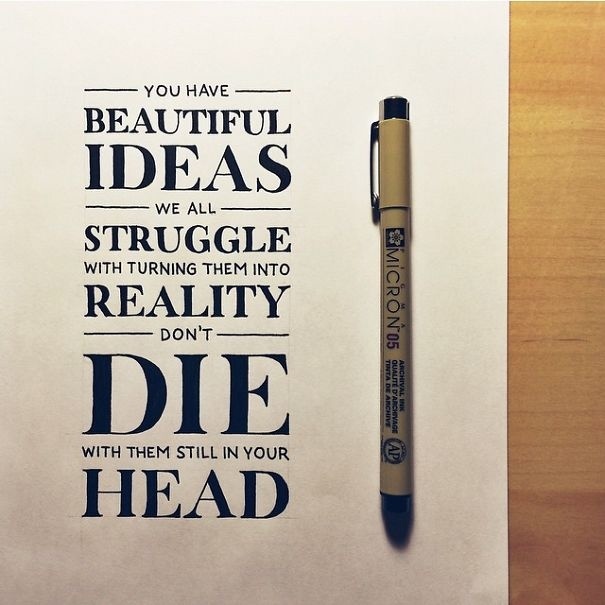
Check out these graphic pieces to possibly inspire your MONDAY

The Tension Of Talent

talent

Talent is potential that has not yet been developed.

Talent alone is not all that special. Everyone has some. The question is what are we going to do with it?

When we take talent, allow it to be developed, then add passion & hustle, we distance ourselves from the masses.

Talent is raw. For it to make an impact, it has to be converted and refined. What we do with our talent is ultimately a stewardship issue. How we handle our allotted talent shows our clear determination on how we feel about one of the greatest gifts we’ve been given.

We might only have a little talent, but a little mixed with a lot of effort can change everything.

Talent and its stewardship requires practice. It takes getting around people who are better than we are, people who work harder than us, people who desire to do things we’ve not done. Talent shouldn’t be measured against others but refined with each other. Community, environment, and culture all impact how well talent is developed. When it’s exposed to healthy creative environments, our talent grows and refines. Likewise, being in environments that do not stimulate our talent causes it to wither.

Sometimes our organizations will position us “to win” and sometimes they won’t, but the stewardship of our talent is only our responsibility and no one else’s!

You are the boss of your talent – no one else.

Sometimes we manage our talent to just survive, and other times we can be a little lazy. Occasionally we’re aware enough to pour into others and coach them and help develop their talents. Rarely do we luck into talent development but, in the end, we have a gift – a raw gift – and we have a choice on how we maximize it. When it’s all said and done, we are given a choice in what we do with our gift.

What do you choose?


An Interview With “The Rev” @GaryVee

GaryVee

Today I had the opportunity to interview Gary Vaynerchuk. Truth be told, I have been on the hunt for this interview for awhile and it met all my expectations. Gary is a social media icon, business man, wine aficionado, and future owner of the NY Jets, sans Tebow.

Three questions, 10 minutes, and lots of gems…but no F-Bombs…(the most commmon question I have received since doing the interview). Tomorrow, Gary will be on CNN with Wolf Blitzer, today he is talking church, social media, and what he would do if he was a pastor.

GVTweet

1. When it comes to non-profits using social media, there seems to be a lack of traction, what is being done wrong and who is doing it right?

  • “The first thing is, just like any twitter account, nonprofits are not thinking things through. What’s the finish line? Everyone wants to “go viral”, add a bunch of Twitter followers and get a bunch of Facebook likes, and gain exposure. But they are not asking the right question. When I launched Wine Library I was not trying to pedal wine, I was looking to change how people communicate about wine. Nonprofits need to identify their purpose, create steps 1,2,3 to achieve that purpose, and then map out the actions it takes to get there. Nonprofits, like a lot of other people, are trying to close on the first move rather than building relationships.”
  • “Honestly, there are no nonprofits crushing it right now but the two that I think are doing the best are Pencils Of Promise and Charity Water. Scott Harrison has done a good job leveraging his platform and profile for people to support his cause. The idea of cashing in your birthday to collect money for a well is great. Scott was an event promoter, he gets it. Adam Braun at Pencils Of Promise, the brother of Scooter Braun, has leveraged Justin Beiber and they are doing some cool things. They are telling good stories and the throw really good events. Their end of the year event was amazing. “

2. As a church, we tell essentially the same story every week for years and years. As a communicator, how do we keep the story interesting?

  • “The greatest stories connect when we prep the audience to hear them. So the best way to be a great storyteller is to make sure people have context for the story you are telling. The best books, movies, songs don’t mean anything if people are not prepped to hear them. We have this gift in social media to help people be prepped in advance and to have context for their stories. We need to use it to prep and to give. When we give we get…”

3. If you were a pastor and you were planting a church in a local community, what would your first hire look like?

  • “When I started working with my dad in the store I told him we needed to focus on March – September. He thought I was crazy. Our holidays were big, Christmas, 4th of July, but I knew those holiday would stay big, if we focused on crushing March – September we would dominate. So if I was a pastor the first thing I would do is hire a Director of Monday – Saturday Operations. This person would be an extrovert. Someone who was super iconic in town and very entrenched in the community. Someone with DEEP ROOTS. They can’t be bashful. I would try to find people who look like me and not obnoxious. This person would hustle and promote. A newscaster type person who knew how to sell.”
  • “In order to communicate about this church i would remind everyone that communications live everywhere. At first I would go big on the core. I would do some research, and based on what that told me, I would go after that audience first. If they are 40-70 year olds, based on what my gut is and what I see, I would be taking out newspaper ads…I would go where this audience lives and capture those who are “church goers”. Then, I would create a plan to attract young people and families. I would focus on storytelling and tell them why this church matters. I would search for what age kids start pushing back on their parents and telling them they don’t want to go to church and I would go after families before they got to that age. I would market to parent websites. I would create something cool for teenage kids, something they wanted to be apart of. And I would probably start a campaign, “2 Sundays a year”. A date in June & October. I would tell families, I am not looking for you to make a commitment, I am looking for you to try 1 of 2 days at my church this year. I would put LOTS of energy into this day and make it a great experience. When you do that you gain equity around this day because it is a win and then a few families continue to come and you start to increase. Actually, this is a really good idea.”

NUGGETS:

  • Effort is in short supply. If you can learn to scale, you will win.
  • I don’t care how many followers you have on your blog, I care because you give. When you give you get.

It is always great to hear someone approach our world, the church world, from a different angle. Thanks Gary for taking the time to chat today and for allowing me to pester you. It is much appreciated.

The #CreativeCommitment

2013a

Photo Props:

We’re kicking off another year – another chance to create, a fresh canvas, and new opportunities to do things that have never been done! So today I ask you to commit with me to have the most creative year possible.

Together, we will commit to:

  • Not allow our emotions to be our only driving force.
  • Finish as well as we start.
  • Hear compliments at the same volume we hear critiques.
  • Have no excuses.
  • Own our faults and our successes.
  • Think creatively.
  • Remember that our value is not found in how people respond to our work.
  • Be intentional to refuel ourselves.
  • Not be intimidated by others, but rather strive to make others better.
  • Choose great over good.
  • Create art that connects as much as it inspires.
  • Trust more than comfort.
  • Lead our teams to greatness.
  • Refuse to be satisfied.
  • Stay alert.
  • Be committed to vision, not projects.
  • Get back up…again…and again.
  • Fight to beat the status quo.
  • Fight to beat our fears.
  • Fight to beat other’s fears that keep us from doing our best work.
  • When we make this commitment together, we can hold each other accountable.

    What do you want to add to this list? Will you commit with me? #CreativeCommitment

    Remix 2012 #1: Worship Leader Process – Paul Baloche

    The top post of 2012 goes to Paul Baloche!

    We continue the Worship Leader Process series this week with Paul Baloche. Don’t forget that when you tweet or post this content on Facebook you register to win some BEATS BY DRE.

    My friend Paul is one of the most prolific worship writers of all time. Chances are if you look at the setlist from your local worship service Paul’s name is on several of the songs. Paul is an avid Beatles fan and leads worship at his local church, Community Christian Fellowship, in Lindel Texas. Paul just released a new album, Same Love, and you can get it here. Now, for the 9 questions with on of the most creative and hardest working guys I know:

    1. What does your creative process look like?

    • It consists of capturing any and all “inspired ideas” that catch my attention. I record the ideas on my iPhone – from prayers, sermons, or everyday life – then I carve out time during the week to listen back to those recordings – worship with them, play with them, and see if anything starts to take shape. I usually have several song ideas going at the same time.

    2. When you write worship songs do you identify a target audience or focus on theme?

    • After an inspired idea starts to take shape I’ll consider what direction or what focus the idea should take, asking “Does this seem like it should be a ballad? an anthem? etc. ” Also, I’ll try to focus the lyric more and more as the song unfolds, expanding on a concept or theme instead of trying to cover the whole Bible in one song.

    3. Do you have a favorite place to write or create?

    • Not really. I’m kind of A.D.D. so staying in one place stifles me. I’ll start off in my church sanctuary or home office, then go for a walk with the ideas floating around, then back home, etc.

    4. What inspires you the most?

    • Life, creation, sunsets, clouds, etc. Visual things inspire me. However, I find that my best “inspired moments” come to me when I’m in the midst of leading worship, praying, getting “lost in God” – when I’m not “trying” to be creative.

    5. When you feel you have hit a creative block, how do you overcome that moment?

    • Listening to new music, checking out some random bands on iTunes can help. Going for a walk, listening to a podcast sermon. That’s also a good time to get with another writer or musician to stir things up.

    6. Do you prefer to create in community or on your own?

    • I love community. I gravitate toward co-writing situations even if I feel like my song idea is almost finished. There is something about getting with a person you trust – sharing stories, coffee, prayer, etc. that leads to something very organic and new. Even if you don’t finish a song, the time was well spent and good for the soul.

    7. What is the hardest part of creating worship sets every week (or as often as you lead worship)?

    • The hardest part would be deciding if you’re teaching too many songs or getting stale. Also, keeping my heart fresh from week to week so that my worship leading doesn’t feel like “a job’ or “a gig”, but rather an overflow of some alone time with God. I typically stand on the platform with my guitar, worshiping or singing scripture when the sanctuary is empty during the week. Maybe an hour on Tuesday or Thursday afternoons. I find that this practice helps me when I show up on Sunday morning and the Church is full.

    8. How do you balance original songs with songs that are leading the global church when you are creating a set?

    • I try not to take advantage of my captive audience (congregation) by pre-screening a lot of my new songs. I generally don’t share a new song of mine unless it stands out and feels strong during rehearsals. Over the years we probably are at a 50/50 ratio of original songs vs. global songs.

    9. Who is the one writer you have not worked with that you would love to write a song with?

    • hmmm. Bono? Jon Foreman? Mark Hall?
    So honored to have Paul part of the blog today.

    2012 Remix #2: 10 Commandments of Creativity

    #2 post of 2012

    We all know the importance of the ten commandments – the golden rule for how we’re supposed to live our lives. But what about a golden rule for our creativity? Blogger Andrew Zahn developed a less sanctimonious list than Moses, but it’s a list that can be adapted to our creative lives. Here’s the list with a little commentary:

    • 1. Give space, time and energy to your creativity. // This is HARD! Our lives are busy, so it can be difficult to be intentional with creating space for us to be our creative best. But, space is important for ideas. Once we have identified an idea, we have to give it space to grow and breathe before we try to execute it. Our best ideas reach their potential when they have space and time around them. Finally, we manage energy. It’s on us. How much energy is attributed to our creativity and our craft ultimately is managed by us – the user and steward. We all have about the same amount of space and energy and we all have the same amount of time. We are going to put our space, time, and energy somewhere. Why not put it into something we value?
    • 2. Creating is an act of worship. // For those of us who are Christians, we know creating is an act of worship to the ultimate Creator of the universe. However, Zahn takes a different angle, an angle that states that when we choose to not create we are actually being “self-centered and selfish.”
    • 3. Your creativity is a gift given to you. // If we’ve been given a gift, we need to cherish, honor, and protect that gift. Even more importantly, we need to share our gifts with others. Give and it shall be given unto you.
    • 4. Date your artist. // Our greatest ideas are going to be birthed out of our experiences. Great art is created when artists are able to connect with emotions that are deep inside themselves. We have to be willing to explore those places to uncover the truths about the artist we are becoming.
    • 5. Don’t be an expert. // Experts know it all. Students are always learning. When we accept the fact that we can always learn more, each person, project, and experience becomes an opportunity to add more tools to our tool boxes. Don’t believe the hype. You are great, but you can be greater. We should talk less and listen more, but whatever we do, we should NEVER STOP LEARNING.
    • 6. Jealousy is the death of creativity. // It’s been said that jealousy is where love and hate both live together. If we want to battle jealousy, we have to do it intentionally. When we champion others, we go on the offensive against jealousy. When we want the people around us to win – no matter the cost – it not only builds great teams, but it removes the temptation to be in competition with one another. Champion and celebrate others at every opportunity.
    • 7. Don’t give up. Don’t give up. // EVER! And if you think about giving up, stop. Take a breath. Then, keep going.
    • 8. You have what it takes. . . now. // God created you. He knew you would be uniquely YOU! If you’re honest with yourself, you probably don’t think you’re good enough for the challenge in front of you. Thats GOOD! If you felt you COULD handle it, that would mean you were able to take the credit for it. When you know you can’t handle it, you have to have an element of faith and trust. Those two ingredients are activators for our best creative endeavors. So, stop doubting. Start believing. Never stop working.
    • 9. Authenticity breeds beauty. // Anyone can duplicate something that has been created. You, however, have walked a road no other artist has traveled. That road gives you the permission to create art that no other artist can create. Create out of that place, and you wont have to worry if you are duplicating.
    • 10. Want what you already have. // Stop comparing. Stop creating excuses. Stop hesitating. Use what’s in front of you, control what you can control, and create something today that moves you and your organization forward!

    Do you resonate with these commandments?

    Remix 2012 #3: Can Creative People Be Leaders?

    The 3rd most popular post of 2012!


    Photo Props

    Have you ever thought that Creativity may actually keep you from being a senior leader in your church or organization? According to a survey done last year for the Journal of Experimental Social Psychology most people are attracted to leaders who remove risk and actually support and reinforce the status quo.

    This is scary.

    With the speed of our world and the turbulence for which we face daily, creativity should not only be encouraged but also championed as a trait of leadership that will help our organizations stay competitive and aggressive. The problem is, creative leaders come with stereotypes: Unreliable, Risky, Lazy, Forgetful, Aloof, Arrogant, Self-Consumed…and the list goes on and on.
    The truth, most of these stereotypes are not true.

    Our organizations need new and fresh ideas. As creative professionals it is our responsibility start destroying these and other stereotypes. It is time for us to be who God created us to be, in his image, creative leaders. We have the opportunity to set a new stereo-type: Passionate, Carrying, Desperately seeking new results, Hard working, Sensitive, In touch with emotion that creates connection, introspective, strategic, and willing to do whatever necessary to share the absolute most important story ever told in an attempt to help people experience life change.
    It’s not something that we can do…it is something we must do.

    We can lead and still be creative…and we will.

    What are some of the stereotypes you experience as an artist? How are you combatting those via your art, work ethic, and approach?

    MONDAY

    The last Monday of 2012.

    Page 7 of 36« First...«56789»102030...Last »